
from 0 review
14 Days
Specific Tour
99 people
Ümit
This 14-day journey follows the historical and cultural backbone of western Anatolia, moving from imperial capitals and early Ottoman centers to the classical cities of the Aegean and the Mediterranean coast. Designed for travelers with a strong interest in history and cultural continuity, the itinerary presents a clear geographic and chronological progression across some of Türkiye’s most significant regions.
The tour begins in Istanbul, where Byzantine and Ottoman legacies are explored through UNESCO-listed monuments and historic neighborhoods, before continuing to Bursa, the first capital of the Ottoman Empire and a key center of early Ottoman identity.
Traveling westward, the route reaches Gallipoli, whose World War I battlefields represent a powerful chapter of modern history, and Troy, the legendary city linking myth, archaeology, and early Anatolian civilization. The journey then follows the Classical Aegean, visiting major ancient centers such as Pergamon, Ephesus, Priene, Miletus, and Didyma.
The final stage moves south through Pamukkale and Sagalassos to the Mediterranean coast, where the Roman cities of Perge and Aspendos, together with the historic old town of Antalya, provide a balanced conclusion between archaeological depth and coastal heritage.
Distances and pacing are carefully planned to maintain comfort while preserving Anatolia’s narrative as a crossroads of empires, faiths, and civilizations.
Arrival in Istanbul and meet & greet at the airport, followed by a transfer to your hotel in the city center. The remainder of the day is free to rest after your international flight or to take a short walk in the surrounding neighborhood, offering a first impression of the city’s atmosphere and daily rhythm. Optional in the afternoon or evening: a traditional Turkish hamam experience, introducing Ottoman bathing culture and long-standing wellness traditions. Overnight in Istanbul.
Today focuses on the historic heart of Istanbul, shaped by successive imperial capitals over more than fifteen centuries. The tour begins at the Hippodrome of Constantinople, once the ceremonial center of Byzantine public life, where chariot races, imperial processions, and political events defined the city’s social landscape. Continue to the Blue Mosque, a refined example of classical Ottoman architecture, admired for its balanced proportions and interior decoration, followed by Hagia Sophia, one of the most influential monuments in world history. Its monumental dome and architectural innovations reflect the city’s layered religious and political past. In the afternoon, visit Topkapı Palace, the former residence and administrative center of the Ottoman sultans. The Harem Section offers insight into court life, hierarchy, and daily routines within the palace. The day concludes at the Basilica Cistern, an underground reservoir demonstrating advanced Byzantine engineering and atmospheric design. Overnight in Istanbul.
Begin the day in Beyoğlu, the historic European quarter shaped by 18th–19th century modernization and Western influence. Walk along İstiklal Street, once the center of embassies, theaters, cafés, and cultural exchange, reflecting Istanbul’s cosmopolitan past. Visit Galata Tower, originally built by the Genoese as part of their medieval trading colony, offering panoramic views over the Golden Horn, Old City, and Bosphorus, providing clear geographic orientation of the city. Later, explore the Spice Market (Egyptian Bazaar), a continuation of Ottoman-era trade networks, followed by Rüstem Pasha Mosque, renowned for its exceptional İznik tile decoration, considered among the finest examples of Ottoman ceramic art. The day concludes with a Bosphorus Cruise, revealing palaces, fortifications, and waterfront mansions while sailing between Europe and Asia, highlighting Istanbul’s unique maritime character. Overnight in Istanbul.
Begin with a visit to the Chora Church (Kariye), one of the finest surviving examples of late Byzantine art, known for its richly detailed mosaics and fresco cycles illustrating theological themes and courtly patronage. Continue with a walk through Fener and Balat, historic neighborhoods along the Golden Horn, where churches, synagogues, mosques, and traditional houses reflect centuries of multicultural urban life and layered community history. These districts offer a perspective on Istanbul beyond imperial monuments, emphasizing everyday life and continuity. In the afternoon, depart Istanbul and drive to Bursa, the first capital of the Ottoman Empire, passing through the Marmara region. Overnight in Bursa.
Today is dedicated to Bursa, the first capital of the Ottoman Empire and a formative center of early Ottoman political, religious, and architectural identity. The tour begins at the Grand Mosque (Ulu Cami), distinguished by its hypostyle plan, calligraphic decoration, and early Ottoman approach to monumental religious architecture. Continue to the Green Mosque (Yeşil Camii) and Green Tomb (Yeşil Türbe), masterpieces of early 15th-century design known for their turquoise tilework and refined proportions, reflecting the empire’s emerging artistic language. Visits to the tombs of Osman and Orhan, founders of the Ottoman dynasty, place the city’s monuments into historical context, emphasizing Bursa’s symbolic importance. The day concludes at Koza Han, a beautifully preserved silk caravanserai that highlights Bursa’s long-standing role in regional and international trade along Silk Road networks. Overnight in Bursa.
Depart Bursa and travel west toward Çanakkale, approaching the Gallipoli Peninsula, a landscape inseparable from the history of World War I. The tour covers key sites across the Gallipoli Battlefields, including memorials, cemeteries, and former front lines associated with the 1915 campaign. The visit places military events within their broader historical context, addressing the human cost of the conflict and its lasting impact on Turkish, Australian, New Zealand, and global memory. The peninsula’s geography—steep ridges, narrow beaches, and exposed terrain—helps explain both the strategy and the tragic outcome of the campaign. In the evening, continue to Çanakkale. Overnight in Çanakkale.
Begin the day at Troy, the legendary city immortalized by Homer and revealed through over a century of archaeological excavation. The site illustrates multiple layers of settlement, spanning more than 4,000 years, linking myth, early Anatolian cultures, and later classical periods. Continue south to Assos, a dramatically positioned ancient city overlooking the Aegean Sea. Known for its well-preserved fortifications and the Temple of Athena, Assos offers insight into regional Greek urbanism and philosophical life, including its association with Aristotle. In the afternoon, drive inland to Pergamon (Bergama), one of the most influential centers of the Hellenistic world. Overnight in Bergama.
Explore Pergamon, visiting its acropolis, steep theater, and sacred precincts that reflect the city’s political power and cultural innovation during the Hellenistic and Roman periods. Pergamon’s role as a center of learning, medicine, and the arts made it a rival to Alexandria in antiquity. Continue to Izmir, modern Smyrna, where a brief orientation and lunch along the waterfront introduce the city’s contemporary Aegean character. The journey then proceeds to Selçuk, visiting the İsa Bey Mosque, an important example of early Anatolian Turkish architecture, followed by St. John’s Basilica, built over the believed burial site of the apostle John. A visit to the Ephesus Archaeological Museum provides essential context for the following day’s exploration. Overnight in Kuşadası or Şirince.
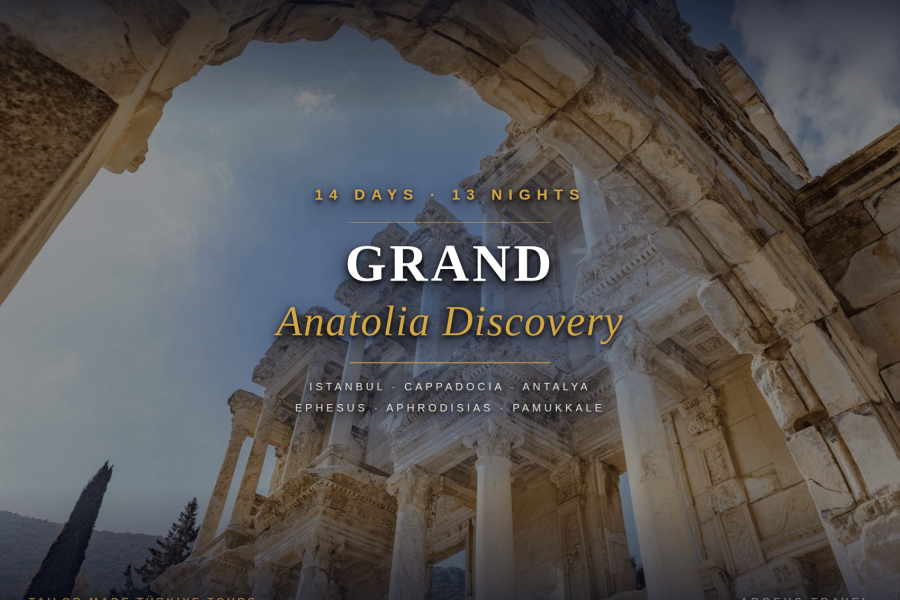
Spend the day exploring Ephesus, one of the best-preserved classical cities in the Mediterranean and a former capital of Roman Asia Minor. Walk along marble-paved streets past the Library of Celsus, Great Theatre, agorae, bath complexes, and temples, illustrating the scale, organization, and daily life of a major Roman metropolis. The visit includes the Terrace Houses, offering rare insight into elite domestic life through mosaics, frescoes, and architectural remains. Continue to the House of the Virgin Mary, a pilgrimage site set in the surrounding hills, associated with early Christian tradition. Overnight in Kuşadası or Şirince.
Today focuses on the Ionian cities, central to the development of philosophy, urban planning, and sacred architecture in the ancient Greek world. Visit Priene, noted for its grid-planned layout and dramatic hillside setting, reflecting classical ideals of urban design. Continue to Miletus, once a major port city and intellectual center, associated with early philosophers such as Thales. The day concludes at Didyma, home to the monumental Temple of Apollo, one of the ancient world’s most important oracle centers, renowned for its scale and unfinished columns. Overnight in Kuşadası or Şirince.
Drive inland to Aphrodisias (UNESCO World Heritage Site), celebrated for its sculpture school and remarkably preserved monuments. The stadium, one of the best preserved in the ancient world, and the city’s sculptural tradition highlight Aphrodisias’s artistic and civic importance. Continue to Pamukkale, where mineral-rich thermal waters have formed striking white travertine terraces over millennia. Explore Hierapolis, including its theater, necropolis, and thermal structures, where natural landscape and Greco-Roman urbanism merge. Overnight in Pamukkale.
Travel south into the Taurus Mountains to Sagalassos, one of Anatolia’s most dramatic archaeological sites. Perched high above the surrounding valleys, Sagalassos is known for its monumental fountains, colonnaded streets, and well-preserved theater, offering insight into Roman provincial life in a mountainous setting. After the visit, continue to the Mediterranean coast, arriving in Antalya, where the tour transitions from inland archaeology to coastal heritage. Overnight in Antalya.
Explore Perge, a major Roman city of Pamphylia, with its colonnaded streets, baths, stadium, and monumental gates. Continue to Aspendos Theatre, famed for its exceptional acoustics and preservation, still used for performances today. In the afternoon, visit Kaleiçi (Antalya Old Town), walking through narrow streets lined with Ottoman houses, Hadrian’s Gate, and the historic harbor. The setting reflects Antalya’s layered past and its long relationship with the Mediterranean. Overnight in Antalya.
Transfer to Antalya Airport for your international departure, concluding your journey through Anatolia’s imperial capitals, classical landscapes, and Mediterranean heritage.
| Group Size (Pax) | Low Season Price (USD per person) |
High Season Price (USD per person) |
|---|---|---|
| 1 | — | — |
| 2 | — | — |
| 3 | — | — |
| 4 | — | — |
| 5 | — | — |
| 6 | — | — |
| 7 | — | — |
| 8 | — | — |
| 9 | — | — |
| 10 | — | — |
* Prices are indicative and may vary depending on travel dates, hotel selection, availability, and final itinerary design. Final pricing is confirmed after itinerary customization.
The data we collect is shared exclusively with our own vehicles (if assigned) or our trusted suppliers for airport transfers. We only share the necessary information such as your full name, arrival/departure flight codes, and accommodation details. Your details are shared in a step-by-step manner; not every supplier receives all pieces of your information, ensuring your privacy and security.
At Argeus Travel, we strive to accommodate our guests in every possible way.

Member Since 2025