
from 0 review
Daily Tour
Daily Tour
99 people
Ümit
This full-day tour explores the Byzantine heritage of Constantinople, focusing on the religious, architectural, and urban legacy of the Eastern Roman Empire. Tracing the city’s development from a Late Antique capital to the heart of Orthodox Christianity, the itinerary highlights monumental churches, underground infrastructure, defensive systems, and monastic centers. Through sacred spaces, imperial architecture, and surviving mosaics, guests gain insight into Byzantine theology, imperial ideology, and daily life. Carefully paced and historically focused, this walking-based experience reveals how Constantinople shaped the Christian East and influenced both medieval Europe and the Ottoman world that followed.
The tour begins at the Church of St. Sergius and Bacchus, built in the 6th century during the reign of Emperor Justinian. Often considered a precursor to Hagia Sophia, the church reflects early Byzantine experimentation with centralized space, domes, and decorative programs. Its scale and design provide important context for understanding imperial church architecture.
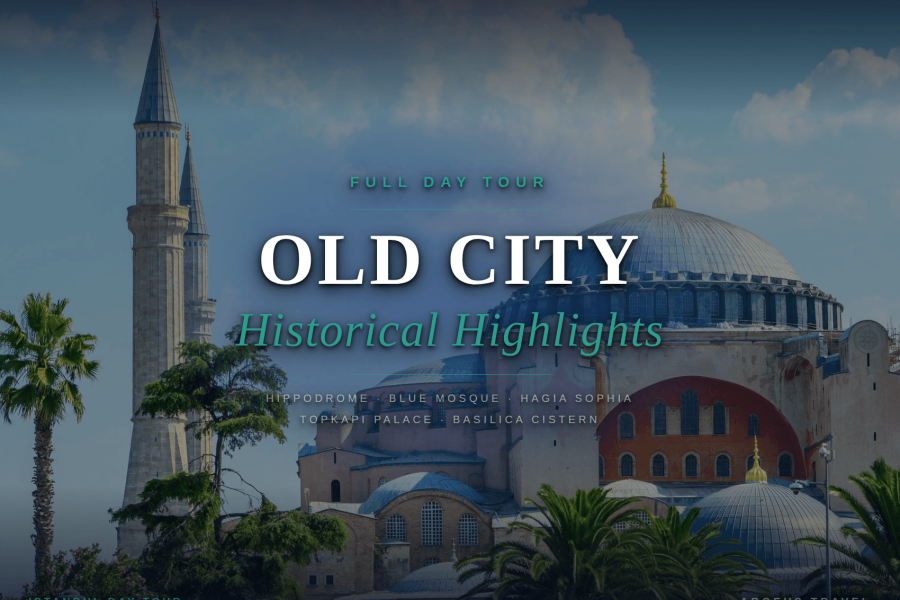
Continue to Hagia Sophia, the most influential monument of Byzantine civilization. Constructed between 532 and 537, the building represents a breakthrough in architectural engineering, combining a massive central dome with a complex structural system. The visit focuses on its original Christian function, imperial symbolism, and theological meaning, as well as its long afterlife and transformations.
Descending into the Basilica Cistern, guests encounter the sophisticated infrastructure that sustained Constantinople. Built in the 6th century, this vast underground reservoir demonstrates the technical skill of Byzantine engineers and the importance of water management in a densely populated imperial capital.
The tour proceeds to the Theodosian Land Walls, constructed in the 5th century and expanded over time. These fortifications protected Constantinople for nearly a thousand years and shaped the city’s growth and military history. The visit explains their design, strategic importance, and role in defining the limits of the Byzantine capital.
The Chora Church represents the artistic high point of late Byzantine culture. Its 14th-century mosaics and frescoes depict complex theological narratives with remarkable artistic refinement. The visit emphasizes the relationship between art, theology, and patronage during the final centuries of Byzantine rule.
The tour concludes at the Church of Pammakaristos, once one of Constantinople’s most important monastic churches. Dating primarily to the Middle Byzantine period, it illustrates the architectural and decorative traditions of the empire beyond the monumental scale of Hagia Sophia and offers insight into monastic life and patronage.
Yes. This tour is operated as a private tour, exclusively for you and your party, accompanied by a professional, licensed tour guide.
This tour is primarily walking-based, combined with public transportation when required to reach sites such as the city walls or Chora area.
This tour involves an estimated X.X km (approximately X.X miles) of walking over the course of the day, equivalent to roughly X,xxx–X,xxx steps. Walking includes movement between sites and time spent inside large monuments. The pace is moderate, with regular stops.
This tour is not fully wheelchair accessible. Several sites include stairs, uneven surfaces, and limited elevator access. Guests with mobility concerns are encouraged to contact us in advance so we can advise on suitability.
We respect guest privacy and personal data. Any information shared with us is used solely for tour operations and communication and is not shared with third parties except where required to deliver services or by law.
Guests are welcome to take their own photos throughout the tour. We do not take photos or videos of guests for promotional purposes without clear prior consent.

Member Since 2025